

Introduction
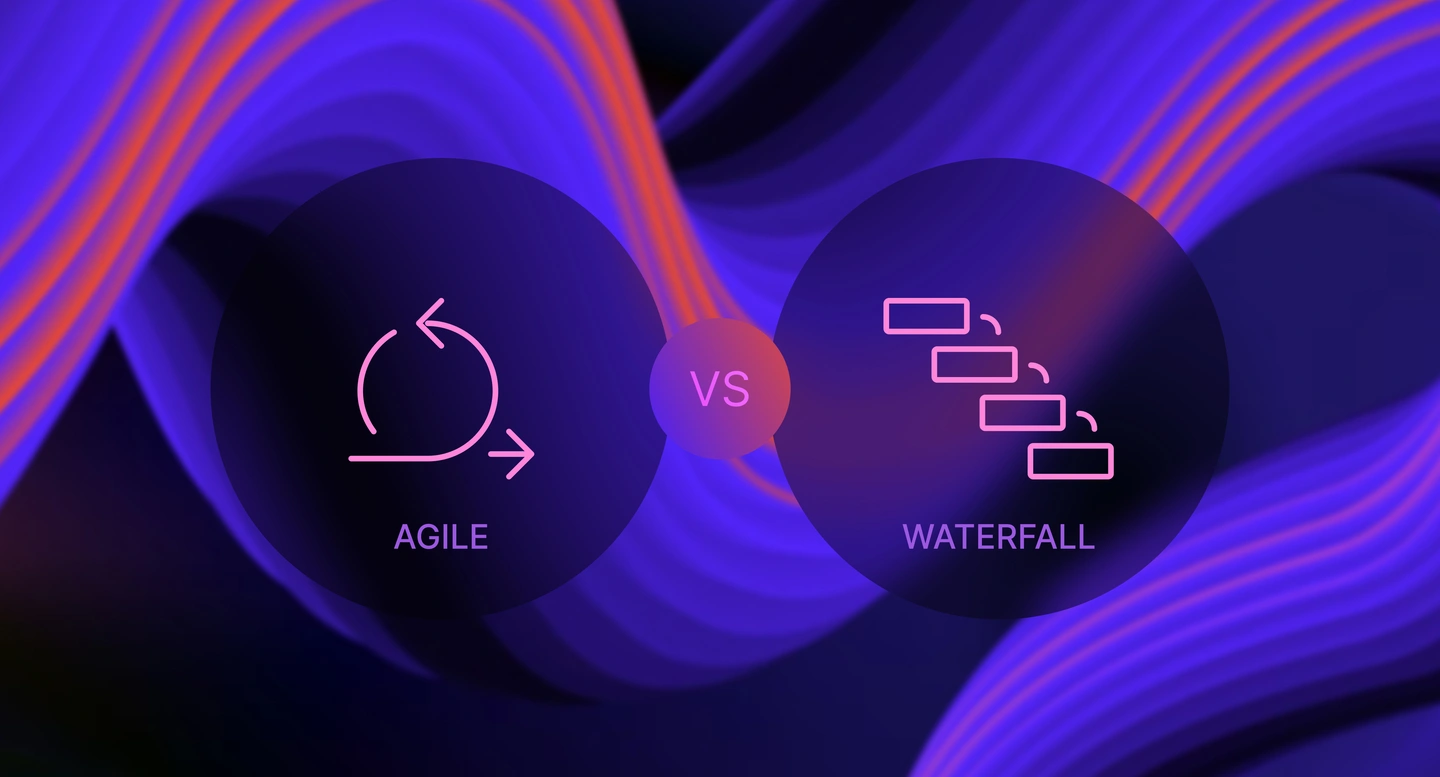
The debate between Agile and Waterfall has persisted for decades in the software development world. While Agile has been the poster child of modern tech innovation, Waterfall has continued to quietly support mission-critical, large-scale enterprise systems.
In 2025, with AI-driven tooling, global remote teams, and rapid iteration cycles, choosing the right methodology isn’t just about speed or structure – it’s about fit, flexibility, and future-readiness.
This blog offers a deep dive into both methodologies with real-world context, platform trends, and expert opinions. Whether you’re building a B2B SaaS product, a mobile app, or a fintech platform, this comparison will help you decide with clarity.
What is the Waterfall Model?
Waterfall is a linear and sequential software development approach, where each phase (requirements, design, implementation, testing, deployment) must be completed before the next begins.
Key Features:
- Fixed scope & timelines
- Heavy documentation
- Minimal client interaction during development
Common Use Cases in 2025:
- Government & defense software
- Healthcare systems with regulatory dependencies
- Legacy infrastructure upgrades
Even in 2025, industries bound by compliance and predictability continue to favor Waterfall for its audit-friendly structure and low tolerance for scope creep.
What is Agile Methodology?
Agile is an iterative, flexible, and user-focused approach to software development that emphasizes collaboration, adaptability, and customer feedback.
Popular frameworks under Agile:
- Scrum
- Kanban
- SAFe (Scaled Agile Framework)
- Extreme Programming (XP)
Why Agile Remains Relevant in 2025:
- Short release cycles (Sprints)
- Continuous integration & deployment (CI/CD)
- Stakeholder visibility and feedback loops
- Fits modern DevOps and AI-automated testing pipelines
Comparison Table: Agile vs Waterfall (2025)
| Criteria | Agile | Waterfall |
|---|---|---|
| Flexibility | High – adapts to change | Low – fixed requirements |
| Timeline | Iterative – sprints | Linear – milestone-driven |
| Client Involvement | Ongoing | Minimal after kickoff |
| Risk Handling | Early and continuous | Detected late (often during testing) |
| Speed to Market | Faster MVP | Slower, but stable |
| Tools Used | Jira, GitHub, CircleCI, Figma | MS Project, Visio, Gantt Charts |
| Industries | Startups, SaaS, Mobile Apps | Healthcare, Aerospace, Finance |
Trends Shaping Agile and Waterfall in 2025
- AI-enhanced Agile: Tools like GitHub Copilot and Tabnine help devs write code faster during sprints.
- Hybrid Agile-Waterfall: Enterprises blend both – using Agile for frontend or innovation teams, and Waterfall for backend or critical systems.
- Data-Driven Agile: Velocity, burndown, and cycle time metrics tracked via Atlassian Analytics and Power BI.
- DevSecOps in Agile: Security integrated from the start with tools like Snyk and GitLab pipelines.
- Waterfall’s Stronghold: Regulated sectors like aviation, public health, and national defense continue to rely on Waterfall.
Pros and Cons in 2025
Agile Pros:
- Faster feedback = fewer surprises
- User stories align closely with business goals
- Enables remote/distributed team collaboration
Agile Cons:
- Difficult to estimate time/cost upfront
- Needs experienced product owners
- Can feel chaotic without clear leadership
Waterfall Pros:
- Predictable planning and budgeting
- Great for fixed-scope contracts
- Easier onboarding for new stakeholders
Waterfall Cons:
- Late feedback = costly rework
- Less adaptable to market changes
- Client disengagement risks misalignment
Which Should You Choose in 2025?
Choose Agile if:
- Your project scope may evolve
- You’re targeting MVPs or rapid market entry
- Your team thrives on collaboration and iteration
Choose Waterfall if:
- Scope, budget, and timeline must be defined upfront
- You’re in a highly regulated environment
- Documentation and approvals matter more than speed
In India & GCC markets, agile adoption is now standard in most IT and digital product firms, while government and defense contractors remain heavily reliant on Waterfall models.
Real-World Case Studies
- Spotify: Runs agile squads and tribes using Scrum + Lean principles for real-time experimentation.
- NASA: Uses Waterfall for critical satellite software with precision and documentation.
- Amazon: Uses micro-agile teams to deploy features within hours.
- Infosys & TCS: Implement hybrid Agile-Waterfall for BFSI clients.
What Experts Are Saying
- “Agile is not a methodology — it’s a mindset. But that mindset must be backed by structure and discipline.” – Jeff Sutherland
- “Predictability is a myth in today’s tech world. Agile helps manage uncertainty, not eliminate it.” – Martin Fowler
- “Waterfall isn’t dead. It’s still the best fit for compliance-heavy industries where clarity trumps flexibility.” – Gartner Research 2025
Future Outlook (2026 and Beyond)
- AI will take over backlog grooming, test writing, and sprint planning
- Hybrid models like Agile@Scale and Dual-Track Development will dominate
- Low-code/no-code tools will push Agile deeper into non-technical departments
For More: The Future of Mobile App Development: AI, UX & Beyond
FAQs (India & GCC Focus)
Q1: Which methodology is preferred for enterprise apps in Chennai or Bengaluru?
Agile is common in product and startup ecosystems, while hybrid models appear in large firms.
Q2: Are GCC governments shifting towards Agile?
Yes. Digital transformation initiatives in UAE and Saudi Arabia are introducing Agile in e-Governance and Smart City projects, while maintaining Waterfall in defense & oil industries.
Q3: Can Agile and Waterfall be combined?
Absolutely. Many firms use Waterfall for planning and compliance, while Agile is used for execution.
Conclusion
The Agile vs Waterfall debate in 2025 isn’t about one being better – it’s about choosing what’s right for the context.
If you need fast validation, evolving features, and cross-team feedback – Agile wins hands down. But if your project demands thorough documentation, fixed timelines, and predictability – Waterfall is still highly relevant.
Choose what aligns with your users, stakeholders, industry, and growth stage.
Call to Action
Whether you lean Agile, Waterfall, or Hybrid – your software needs the right foundation.
BlazeDream helps businesses across 30+ countries choose the best delivery model while building world-class, future-proof software systems.
Email: reach@blazedream.com
Website: www.blazedream.com
Let’s build your next big idea – with agility, clarity, and confidence.